BOX CULVERTS

APPLICATION Specifications

There are a variety of ways to seal box culverts. The sealing solution – and the products and installation methods recommended to achieve each sealing solution – depends heavily on the structure’s end use, service conditions, and surrounding environment. Some factors to consider are whether the structure will convey or hold water, the depth of bury, the water table depth, whether the structure is required to be watertight, and whether chemicals or contaminants are expected to be in contact with the structure, among others. ConSeal can help provide an overview of terminology, applications, and considerations for the most common box culvert situations.

Consult with the Concrete Sealants engineering team for specific guidance. 

Application Specifications

WHAT TYPE OF SEALING MATERIAL IS NEEDED?

Preformed flexible joint sealants are designed to create a gasket in a compression joint between two concrete mating surfaces. The sealant is intended to seal against soil, silt, and moisture intrusion as well as varying levels of hydrostatic pressure in certain conditions. The sealant required for a job depends on the project specifics including the end use of the structure, soil and site conditions, depth of bury, and structure dimensions, among others.

If no special circumstances exist, butyl rubber sealants like CS-102, CS-202, or CS-250 are appropriate preformed flexible joint sealants for the job. In situations where petroleum such as oil or jet fuel may be present, a hydrocarbon-resistant sealant like CS-440 may be required. If harsh chemicals are present in the surrounding groundwater or in the water or wastewater traveling through the structure, a sealant with robust chemical resistance like CS-5000 may be needed. For potable water applications, sealant rated for use with drinking water, like CS-665, should be used.

Some scenarios may only require use of preformed flexible joint sealants, while other scenarios may require a suite of products to achieve the desired performance in service including a combination of some or all of the following: preformed flexible joint sealants, waterstop sealants, gun-grade sealants, external joint wraps, coatings, admixtures, topical sealers, primers, and adhesives.

WITH WHICH STANDARDS DO SEALING MATERIALS NEED TO COMPLY?

Generally, ASTM or AASHTO standards are specified for most sealing material. These standards define the composition and performance requirements of different products, including preformed flexible joint sealant, external joint wrap, and gun-grade material.

ASTM C990, “Standard Specification for Joints for Concrete Pipe, Manholes, and Precast Box Sections Using Preformed Flexible Joint Sealants.”
ASTM C877, “Standard Specification for External Sealant Bands for Concrete Pipe, Manholes, and Precast Box Sections.”
ASTM C920, “Standard Specification for Elastomeric Joint Sealants.”
AASHTO M 198, “Joints for Circular Concrete Sewer and Culvert Pipe Using Flexible Watertight Gaskets.”
Federal Specification SS-S-210 (210-A), “Sealing Compound, Preformed Plastic, For Expansion Joints and Pipe Joints.”

In some cases, such as hydrocarbon or chemical resistance, a special sealant material must be used. These special sealants do not have material standard specifications.

SELECTING THE PROPER PREFORMED FLEXIBLE JOINT SEALANT

To properly understand the best methods of sealing the joints of concrete structures, some of the myths and misconceptions about sealants must be discussed. Laboratory testing and engineering analysis have led to some “rules of thumb” when selecting and applying preformed flexible joint sealants in a compression joint – in this case for a box culvert.

HOW MUCH SEALANT IS NEEDED?

The answer is as varied as the types and sizes of precast concrete box culvert sections produced. A misconception is that more joint sealant is better. However, too much sealant – or too little sealant – can result in leaky joints. The amount of sealant required is based on the structure’s dimensions and joint details, and the volume of sealant needed to sufficiently fill the joint gap.

Ideally, sealant coverage is preferred throughout as much of the wall thickness and joint width as possible. A minimum compressed sealant width in the joint of about 2”-3” is common, but a greater width of coverage is preferred. The joint tightness must be such thatthe sealant is compressed a minimum of 50% of its original height. However, it is preferred that the joint be as tight as possible.

Preformed flexible joint sealants are manufactured in a variety of heights, widths, cross-sectional areas, and roll lengths, so there may be more than one way to achieve the required sealant volume. Additionally, the required volume of sealant may be achieved by using several smaller strips of sealant rather than one larger strip of sealant. Consideration should also be given to the height of the sealant vs. the dry fit joint gap and the ability to compress the sealant adequately.

WHAT SHAPE OF SEALANT IS NECESSARY?

As sealant compresses, it retains its cross-sectional area. That is, as sealant compresses and gets thinner, the compressed sealant becomes wider proportionally. As a result, the cross-sectional area of the compressed sealant will be roughly equivalent to the non-compressed sealant.

As the sealant is compressed, the pressure required to achieve further sealant compression increases as a function of the percentage of compression achieved thus far. Time, temperature, force, and the sealant composition affect the compression rate. For instance, the pressure needed to compress the sealant the initial 10% to 50% may range from 2 psi to 4 psi. However, it may require about 12 psi of applied pressure to achieve 85% compression. As the sealant is compressed, it increases in width, thus increasing the area to which the compression force is applied. Eventually, the area reaches a point of balanced pressures with the designed resistance pressure of the sealant and compression will stop. An analogy to describe this is the use of snowshoes to distribute a person’s weight to allow them to walk across snow without sinking. The person’s weight remains the same (as does the force applied to the sealant), however the area across which the person’s weight is applied is increased by the use of snow shoes (and the sealant area to which the compression force is applied is increased as the sealant compresses), which reduces the pressure applied to the snow (and similarly reduces the pressure applied to the sealant).

WHY IS SURFACE PREPARATION IMPORTANT?

How well the concrete joint surface is prepared affects the joint’s hydrostatic resistance. Water finds the path of least resistance, and if the concrete joint surface is not properly prepared or the concrete is of poor quality (i.e. porous concrete, excessive bugholes, uneven surfaces, damaged concrete, contaminants, etc.), water can bypass the sealant and potentially compromise the system’s watertightness. This can result in leaks or wetness in or near the joint.

Preformed flexible joint sealants will perform best when applied to a dry, clean, sound, uniform, and well-cured concrete surface that is free of dust, dirt, form release agent, or anything else that may inhibit sealant adhesion or joining the concrete sections together. Hydrostatic resistance of the joint can be improved through surface preparation such as patching the concrete, filling bugholes, cleaning and drying the concrete, priming the concrete, coating the concrete, or using concrete permeability reducing products.

WHERE SHOULD THE SEALANT BE PLACED?

Sealant placement is critical for any application. The best practice is to place sealant where the concrete touches tightest. It is also preferred to fill the annular space as much as possible. The sealant should compress and fill the joint such that the interface at the wall where fluid is anticipated is filled. This may be on the inside of the structure, on the outside, or both. If the seal should stop infiltration and exfiltration, two rows of sealant should be used. Perform a sealant fitment test prior to final structure installation to ensure optimal sealant size and placement. Refer to the sealant technical literature for additional placement details.

Consult with the Concrete Sealants engineering team for specific guidance.

SEALING A BOX CULVERT

HOW SHOULD PREFORMED FLEXIBLE JOINT SEALANT BE INSTALLED?

There are two primary methods for installing preformed flexible joint sealant on box culvert joint surfaces, and the ideal methodology for each application depends heavily on the structure’s end use and the structure’s joint anatomy. Both methods are used to create a perimeter seal around the structure’s joint, however they employ different strategies to achieve it.

METHOD A: CONTINUOUS

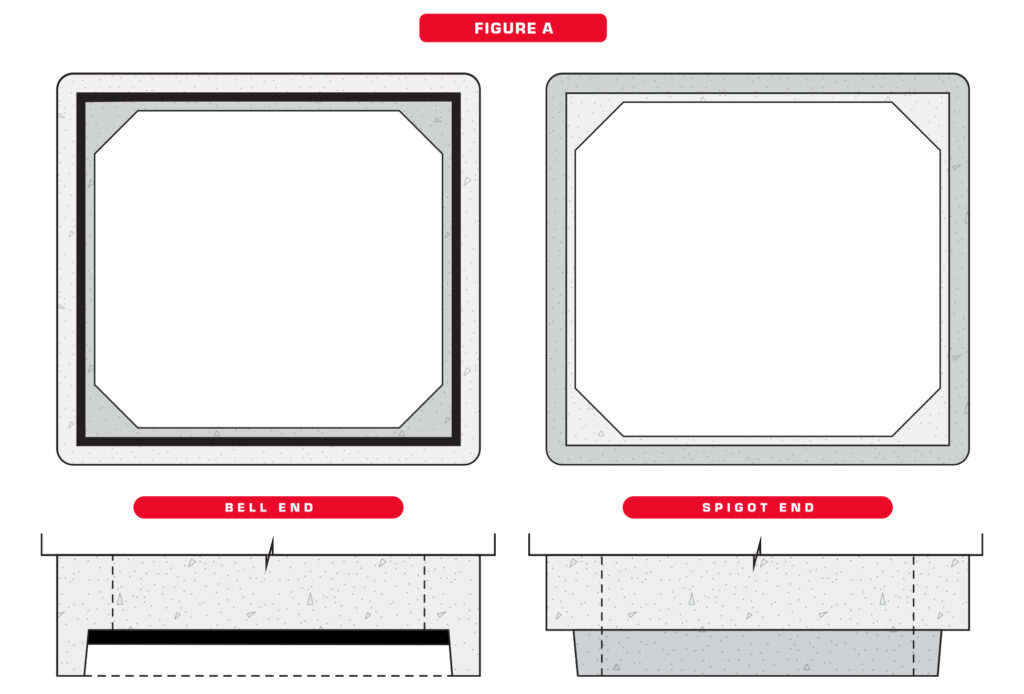
Method A involves applying the joint sealant in a continuous application around the entire box culvert joint face. This method may require multiple rolls of sealant to travel the entire distance around the joint face, but the sealant is applied only to one joint face. See Figure #A. Method A provides greater reassurance of achieving a proper seal over the other method, Method B.

PROS: Continuous sealant application. Can knead ends of sealant together for homogeneity.
CONS: May have to suspend the sealant upside down in the bell using an adhesive like CS-1550.
USES: METHOD A MAY BE USED FOR ANY BOX CULVERT APPLICATION: SOIL-TIGHT, SILT-TIGHT, LEAK-RESISTANT, OR WATERTIGHT.
 

METHOD B: NON-CONTINUOUS

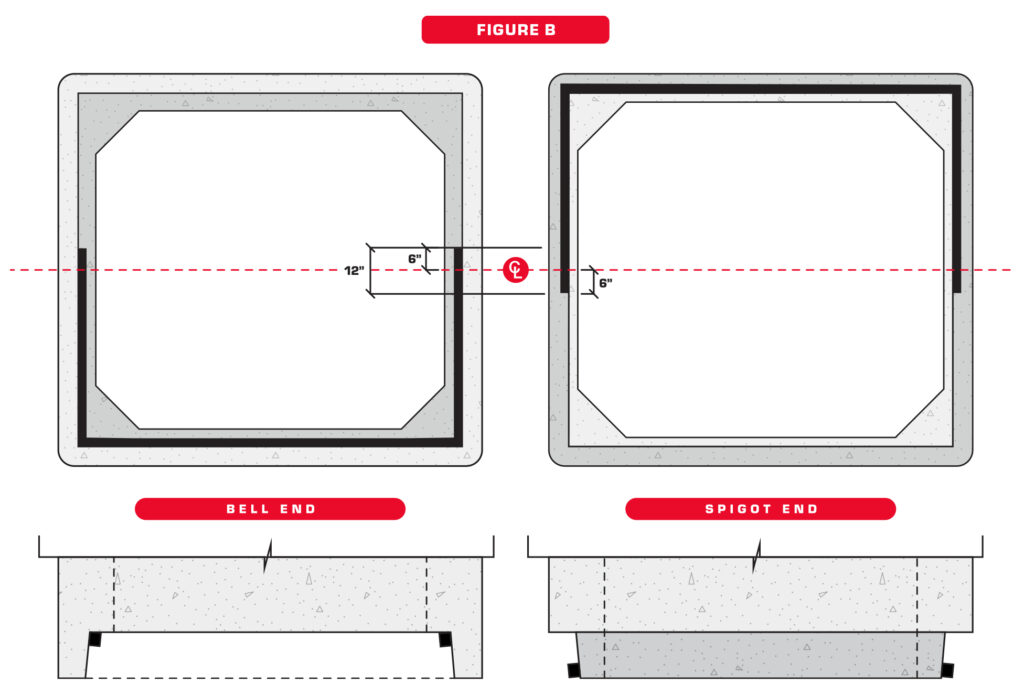
Method B involves applying the joint sealant in a non-continuous application on two adjoining box culvert joint faces. This method may also require multiple rolls of sealant, however with this method, the sealant is installed in a U-shape to one box culvert joint face (the bell end) and additional sealant is installed in an upside-down-U-shape to the adjoining box culvert joint face (the spigot end). When the two structure faces are joined together, the two portions of sealant come together to create a perimeter of sealant around the entire joint face. The positioning of the sealant on both structures must allow for 12” of sealant overlap at the structures’ mid-height on both sides. See Figure #B.

PROS: Do not have to suspend sealant upside down.
CONS: No certainty that the U-shape sealant on the bell and upside-down-U-shape sealant on the spigot will align. Unable to knead the sealant together to create a homogeneous rope of sealant.
IMPORTANT NOTE: METHOD B MUST ONLY BE USED FOR SOIL-TIGHT OR SILT-TIGHT BOX CULVERT APPLICATIONS. IT SHALL NOT BE USED FOR LEAK-RESISTANT OR WATERTIGHT APPLICATIONS.
THE PROPER SEALING APPROACH

Different sealing solutions and ConSeal product combinations are needed for different box culvert applications.
The “Level 1: Soil-Tight” approach is the simplest sealing solution. Sealing solutions increase in robustness as the levels increase up to “Level 5: Watertight – Special.”

ALWAYS CONSULT WITH CONCRETE SEALANTS ENGINEERING BEFORE PROCEEDING WITH MATERIAL SELECTION OR PROCUREMENT.

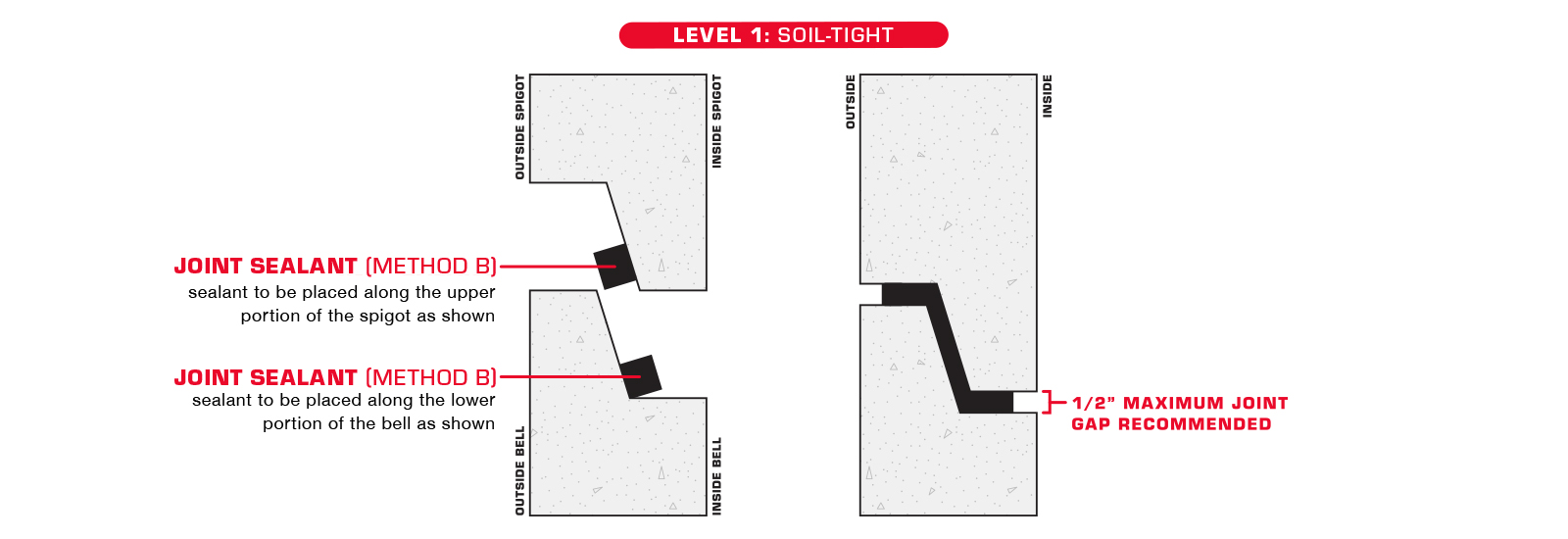
LEVEL 1: SOIL-TIGHT

APPLICATIONS: Low-risk situations.
EXAMPLES: Stormwater conveyance.
ADVISORIES: Not for use with wastewater, hydrocarbons, chemicals, holding structures, contaminated soil, contaminated groundwater, deep bury structures, or where watertightness is required.

PRODUCTS:
CS-102 sealant installed using Method A or Method B. OPTIONAL ACCOMPANIMENT: CS-1550 adhesive.
LEVEL 2: SILT-TIGHT

APPLICATIONS: Low-risk situations.
EXAMPLES: Stormwater conveyance.
ADVISORIES: Not for use with wastewater, hydrocarbons, chemicals, holding structures, contaminated soil, contaminated groundwater, deep bury structures, or where watertightness is required.

PRODUCTS:
CS-102 sealant installed using Method A or Method B. OPTIONAL ACCOMPANIMENT: CS-1550 adhesive.
CS-212 wrap. OPTIONAL ACCOMPANIMENT: CS-50/CS-75 or CS-80/CS-85 primer.
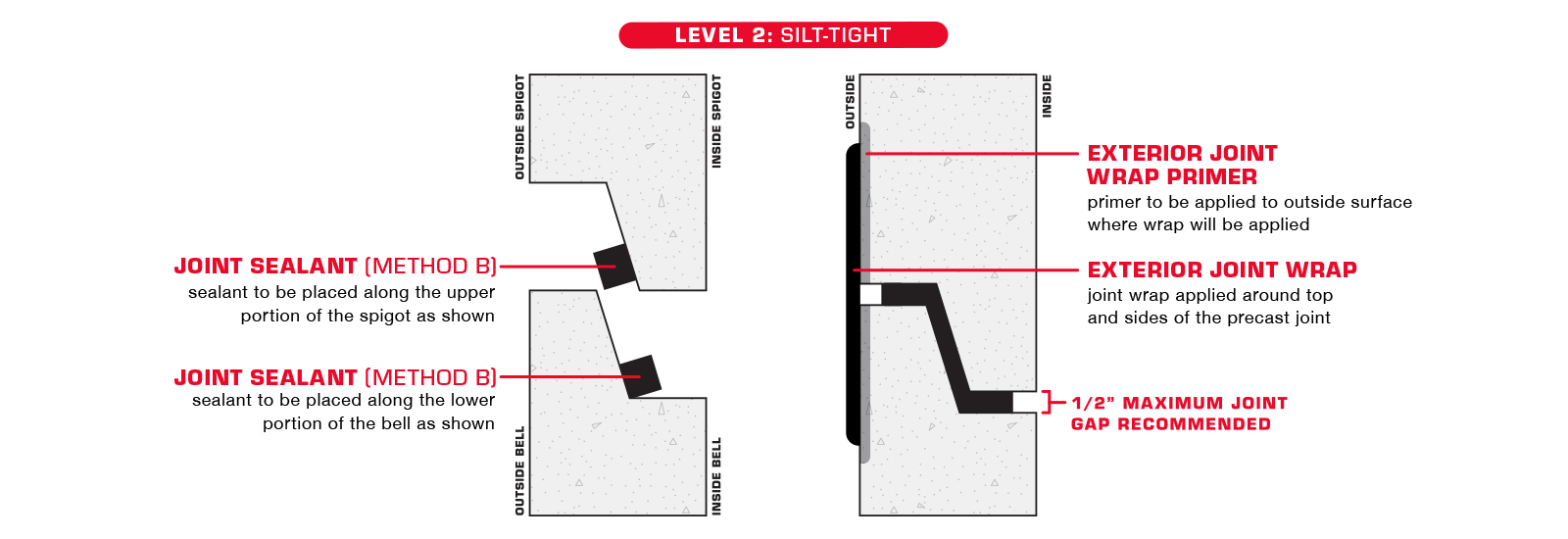
LEVEL 3: LEAK-RESISTANT

APPLICATIONS: Low-risk to medium-risk situations.
EXAMPLES: Stormwater conveyance.
ADVISORIES: Not for use with wastewater, hydrocarbons, chemicals, holding structures, contaminated soil, contaminated groundwater,deep bury structures, or where watertightness is required.

PRODUCTS:
CS-102. sealant installed using Method A only. REQUIRED ACCOMPANIMENT: CS-1550 adhesive.
CS-212 wrap. OPTIONAL ACCOMPANIMENT: CS-50/CS-75 or CS-80/CS-85 primer.
OPTIONAL SECOND ROW (LARGER STRUCTURES): CS-102 or CS-235 sealant installed using Method A only. REQUIRED ACCOMPANIMENT: CS-1550 adhesive.
OPTIONAL: CS-1500 elastomeric sealant (interior). REQUIRED ACCOMPANIMENT: CS-80/CS-85 primer.
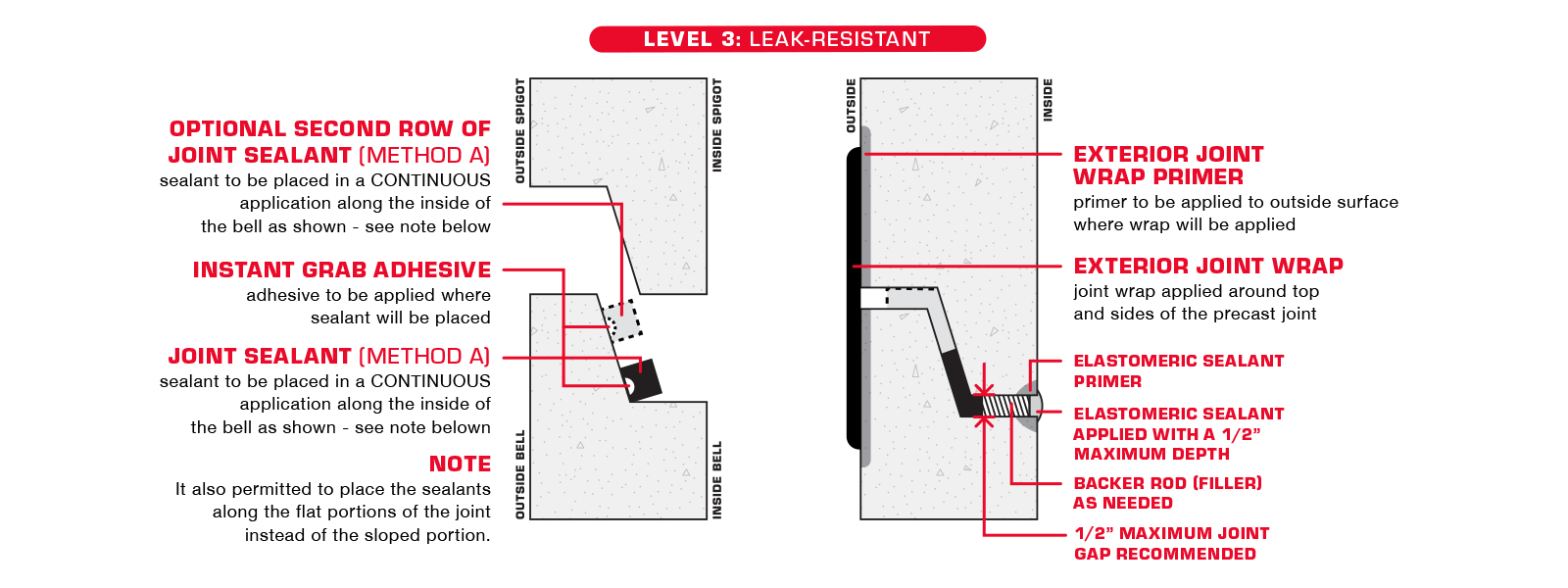
LEVEL 4: WATERTIGHT-STANDARD

APPLICATIONS: Medium-risk to high-risk situations.
EXAMPLES: Stormwater, wastewater.
ADVISORIES: Not for use with hydrocarbons, chemicals, contaminated soil, contaminated groundwater, or deep bury structures.

PRODUCTS:
CS-102 sealant – two rows, installed using Method A only. aREQUIRED ACCOMPANIMENT: CS-1550 adhesive.
ALTERNATE: CS-102 sealant (interior) and CS-235 waterstop sealant (exterior) installed using Method A only. REQUIRED ACCOMPANIMENT: CS-1550 adhesive.
CS-212 wrap. OPTIONAL ACCOMPANIMENT: CS-50/CS-75 or CS-80/CS-85 primer.
CS-1500 elastomeric sealant (interior). REQUIRED ACCOMPANIMENT: CS-80/CS-85 primer.
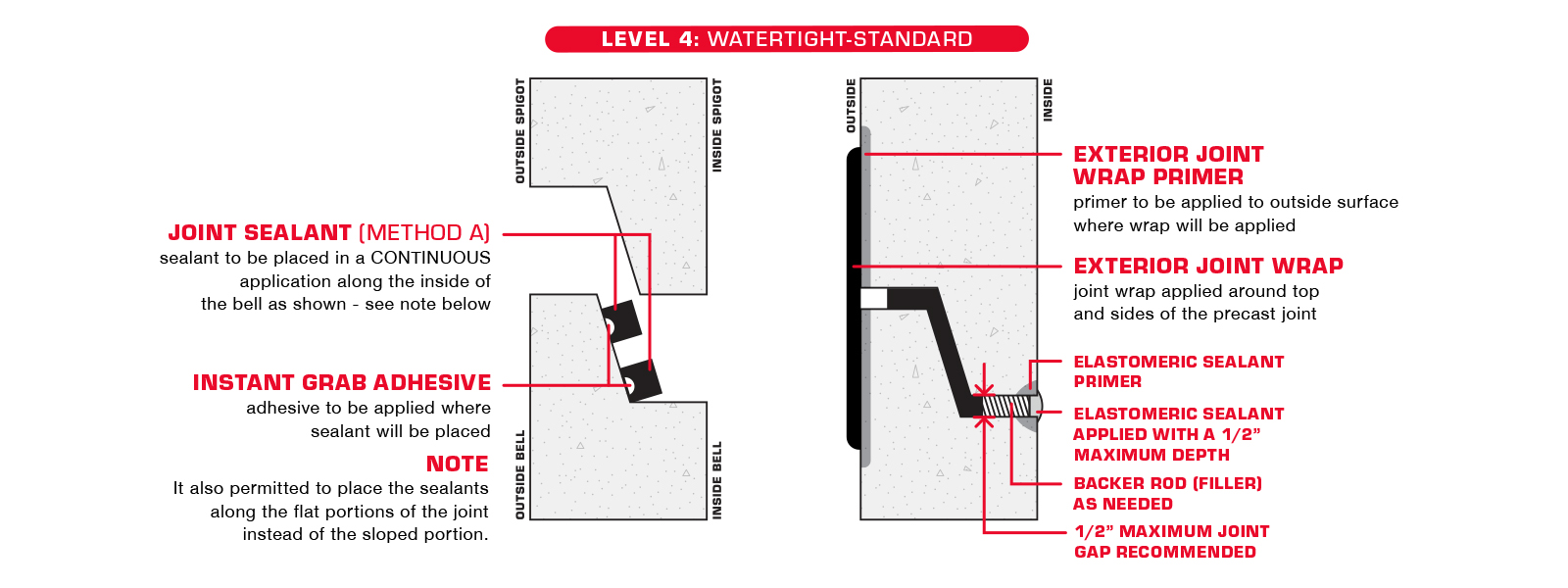
LEVEL 5: WATERTIGHT-SPECIAL

APPLICATIONS: High-risk situations.
EXAMPLES: Hydrocarbons, chemicals, contaminated soil, contaminated groundwater, or deep bury structures.

PRODUCTS:
CS-5000 waterstop sealant – two rows, installed using Method A only. REQUIRED ACCOMPANIMENT: CS-1550 bedding adhesive and CS-5000SA bonding adhesive.
CS-414 wrap. OPTIONAL ACCOMPANIMENT: CS-50/CS-75 or CS-80/CS-85 primer.
CS-1440 elastomeric sealant (interior). NOTE: Do not use a primer with CS-1440.
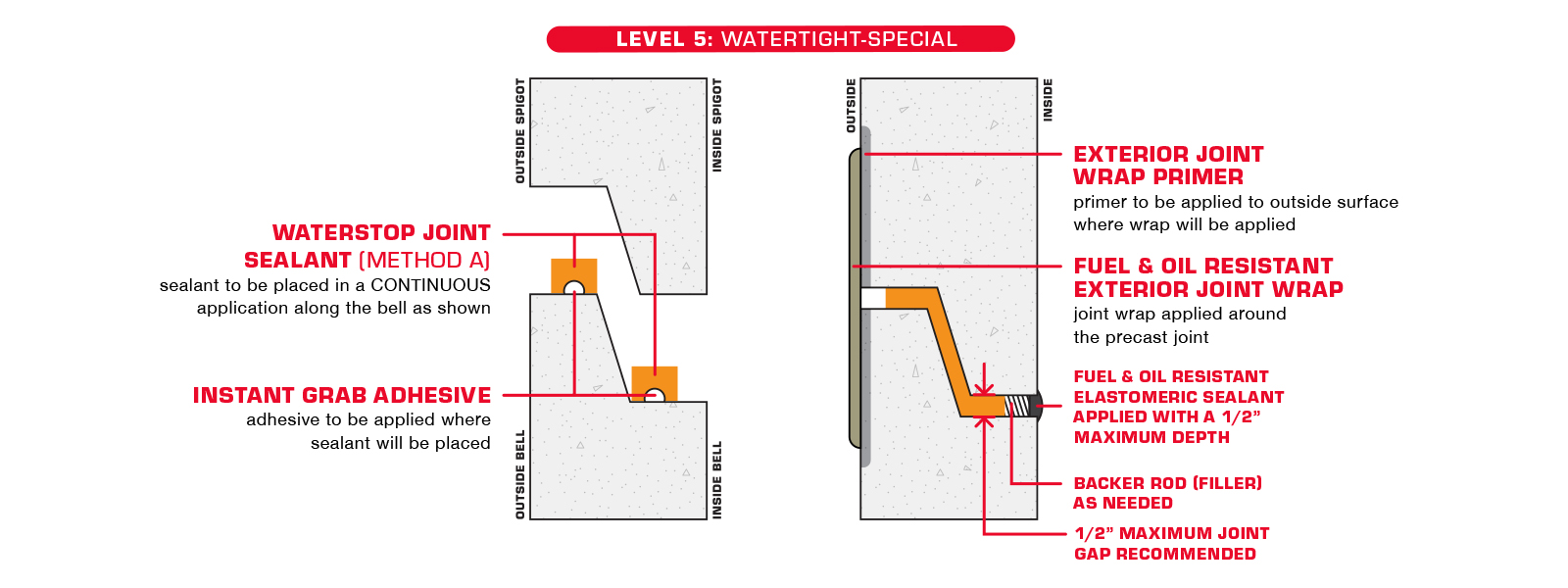
t

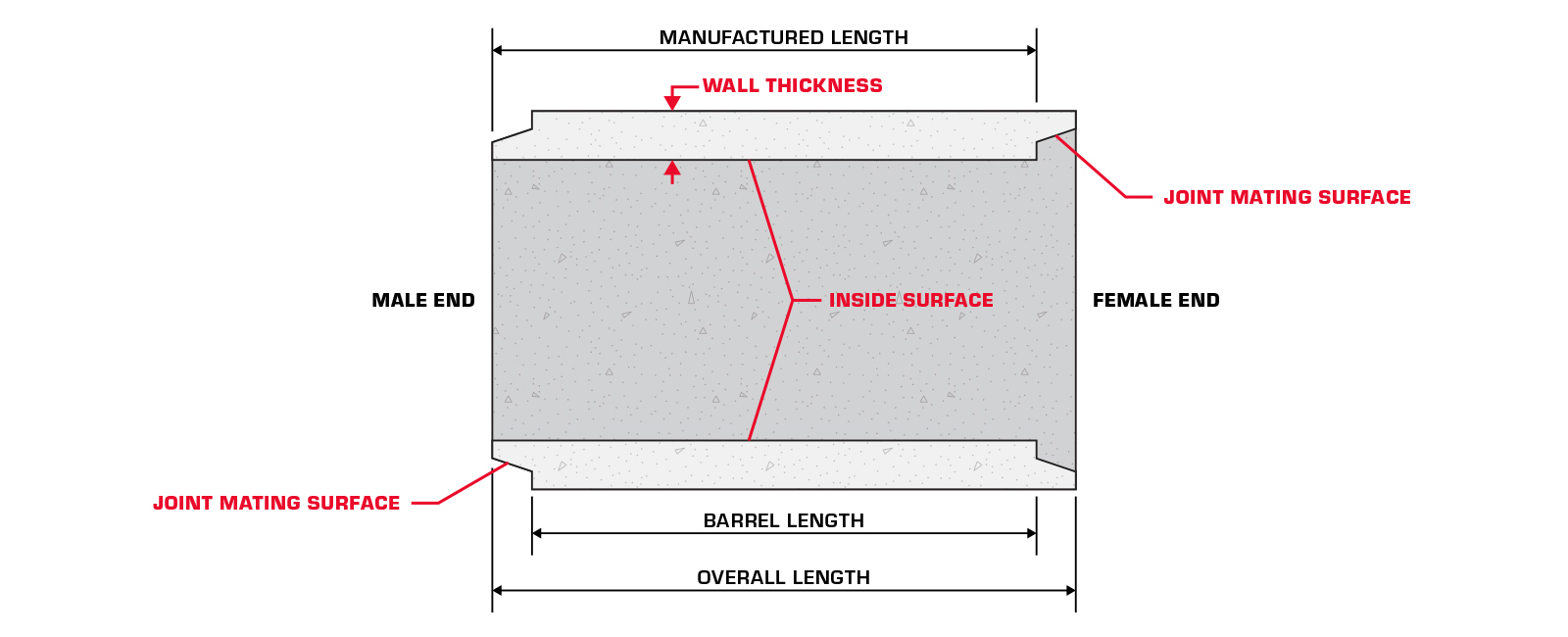
Anatomy of a box culvert


FOR OTHER SPECIAL CIRCUMSTANCES, ALTERNATIVE SEALING MATERIALS OR COMBINATIONS OF MATERIALS MAY BE RECOMMENDED BY THE CONCRETE SEALANTS ENGINEERING TEAM.

GLOSSARY OF TERMS

ANNULAR SPACE: The intentional void space between the inner joint mating surface of the female end and the outer joint mating surface of the male end of an assembled precast concrete structure.
BUTYL RUBBER: Hydrocarbon-based material used in combination with other raw materials to produce many types of preformed flexible joint sealant.
COMPRESSION JOINT: A surface between two mating concrete sections where force is to be applied to compress the sealant material.
CONVEYANCE: The process of transporting liquid from one place to another; not intended to continuously hold liquid.
EXTERNAL JOINT WRAP (External Sealing Band, External Joint Membrane): Permanent, flexible membrane applied over the exterior joint surfaces of buried structures to seal against water and soil intrusion.
FEMALE END (Bell, Socket, Groove, Modified Groove): The portion of the end of the structure – regardless of its shape or dimensions – which overlaps a portion of the end of the adjoining structure. The part of the joint surface that is inside the joint.
GUN-GRADE SEALANT: Caulkable sealing material used to fill remaining joint gap of assembled structures. Also known as elastomeric sealant.
HYDROSTATIC PRESSURE: Pressure exerted by a fluid at equilibrium due to the force of gravity.
JOINT: A connection of two ends of any precast concrete structures.
JOINT GAP, ASSEMBLED: Separation between two adjoining sections, after assembly, as a result of the joint design, joint sealing material, and installation.
JOINT GAP, DRY FIT: Separation between two adjoining sections when fit together without sealing material; used in conjunction with other information to determine appropriate sealing material selection, sizing, and placement.
JOINT MATING SURFACE: Portions of the joint with intentional contact between adjoining sections during dry fit.
LEAK-RESISTANT: Installation system intended to resist passage of water through the joint or concrete to a standard test criteria.
MALE END (Spigot, Tongue, Modified Tongue): The portion of the end of the structure – regardless of its shape or dimensions – which is overlapped by a portion of the end of the adjoining structure. The part of the joint surface that extends out of the joint.
PREFORMED FLEXIBLE JOINT SEALANT: Rope-style sealing material designed to be compressed in structure joints to seal against water and soil intrusion.
SILT-TIGHT: Installation system intended to prevent silt intrusion in joints; not leak-resistant.
SOIL-TIGHT: Installation system intended to prevent soil intrusion in joints; not leak-resistant.
WATERSTOP SEALANT: Hydrophilic sealing material that absorbs water and swells to seal against water and soil intrusion.
WATERTIGHT: Installation system intended to prevent passage of water through the joint or concrete to a standard test criteria.

Disclaimer: This publication is to assist users to understand the proper use of ConSeal’s products. Contact ConSeal’s technical staff for practices and procedures that meet your specific requirement. Concrete Sealants, Inc. does not warranty any improper use of its products.

How can conseal help you today?

Are you looking for specific information or just need to talk to someone? We can help.